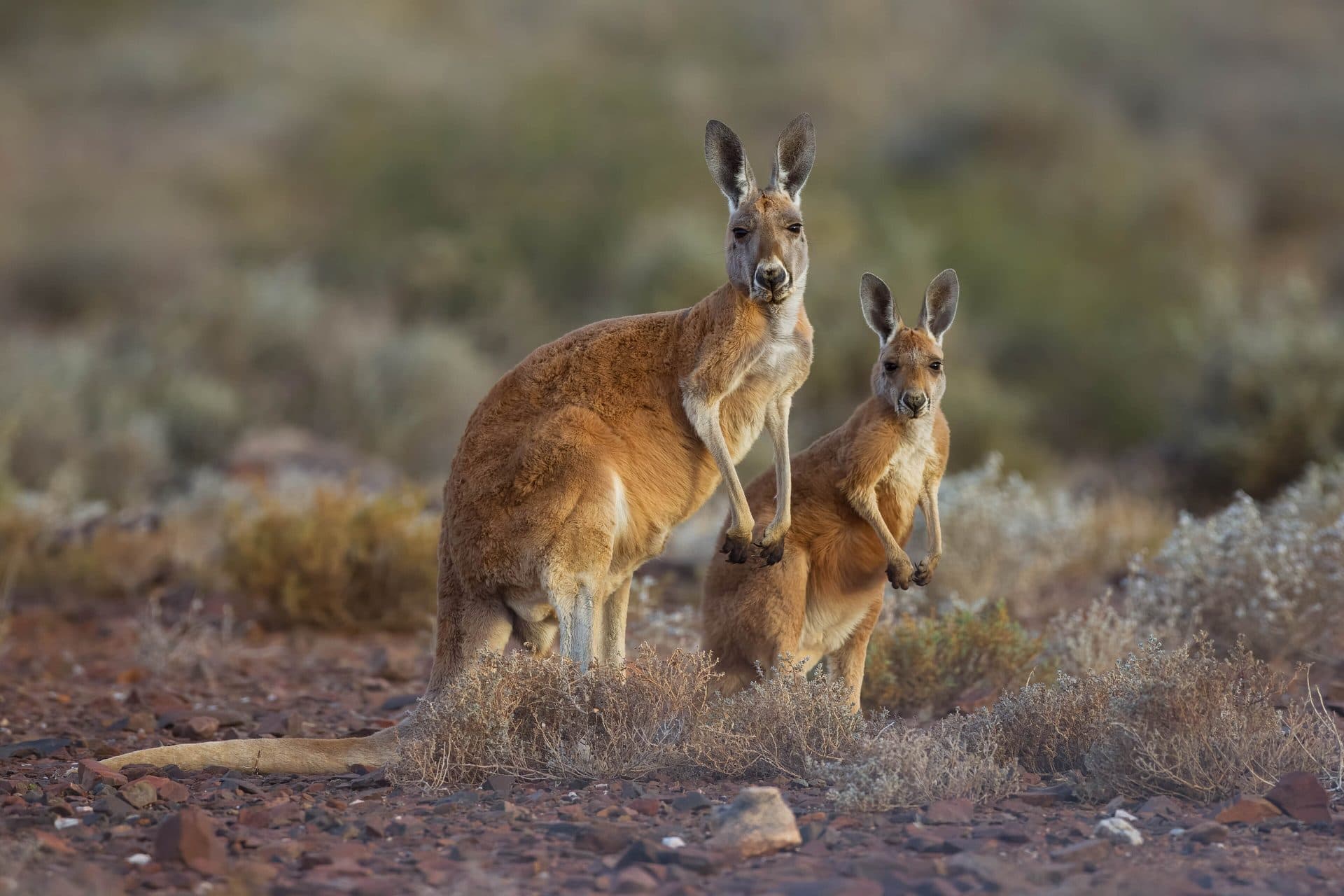
Kangaroos
| The sources of this information are provided under Resources | ||
Aliases |
||
| Taxonomic classification | ||
| Superfamily | Macropodoidea | big footed 62 species in Australia & Papua New Guinea size 1 kg - 90 kg |
| Family | Macroprodinae | kangaroos and wallabies |
| Genus | Macropus | kangaroos six largest species of the family |
Relationships among Kangaroos
| Genus | Macropus Kangaroos share:
|
|||||
| Species | rufus | fuliginosus | giganteus | antilopinus | robustus | bernadus |
| Common Names | Red Kangaroo, Marloo. Blue-flier (female) |
Western Grey, black-faced kangaroo, sooty kangaroo, mallee kangaroo, stinker | Eastern Grey, forester, scrubber, Great Grey | Antilopine Kangaroo | Common Wallaroo, Euro, briggada | Black Wallaroo |
| Grouping | Red Kangaroo | Grey Kangaroos | Antilopine Kangaroo | Wallaroo / Euro |
||
Appearance |
||||
| Species | males | females | ||
| Height* | Weigh | Height* | Weight | |
| Red Kangaroo | 1.8 m | 90 kg | 1.25 m | 35 kg |
| Grey Kangaroos | 1.6 m | 70 kg | 1.2 m | 35 kg |
| Antilopine Kangaroo | 1.5 m | 49 kg | 1.0 m | 20 kg |
| Euro | 1.6 m | 58 kg | 1.2 m | 25 kg |
| Black Wallaroo | 1.0 m | 22 kg | 0.8 m | 13 kg |
| * Height is measured when sitting up on their haunches. | ||||
| Red Kangaroo | black and white patch at side of muzzle; the tip of the nose is naked and sharply outlined |
| Grey Kangaroos | muzzle covered by fine hair; only the margins of the nostrils are bare black skin |
| Euro - Wallaroo | nose is completely naked |
Behaviours |
|
Social interaction |
|
| these are actions that promote the unity of a group; don't include either displays of aggression or reproductive behaviour | |
Between group members: |
|
| mutual nose touching and sniffing, touching the lips of another, other touching and sniffing, grooming others, nuzzling a female's pouch | |
| submissive behaviour - one animal, often smaller, holds its body close to the ground and its head may quiver | |
| play-fighting among young, subadults, or mother and young - two animals involved grasp each other around the neck, touching forepaws and kicking | |
Mother and offspring: |
|
| mother grooms a young at foot while it is suckling or just after | |
| young nuzzles its mother's pouch either to get in or to suckle or for reassurance the young may put its head into the pouch for a few seconds | |
| young licks its mother's lips for several minutes, apparently collecting saliva; it is thought that this may result in the passage from mother to young of the digestive micro-organisms required for the fermentation of vegetation for nutrition | |
| play-fighting | |
Aggression |
|
| fights ('boxing') between large males are rare | |
| most fights are one-sided and end quickly; the challenged individual usually moves away | |
| a submissive 'cough'/cluck is heard in eastern greys, wallaroos, euros but not in reds | |
| threat displays indicate an intention to act aggressively; these include upright posture, stiff-legged walking, pulling on grass or bushes | |
Distribution |
| Species | Habitat preference |
| Red Kangaroo |
|
| Western Grey Kangaroo |
|
| Eastern Grey Kangaroo |
|
| Antilopine Kangaroo |
|
| Euro group (4 subspp) |
|
| Black Wallaroo |
|
Feeding |
|
| reds and greys may feed in large mobs - size depends on the quality of food | |
| most active at dawn and dusk; relatively inactive in middle of both day and night | |
| time spent grazing varies seasonally between 7 and 14 hours | |
| rest during the day in the shade of woodland; move onto grasslands to feed | |
| eat a variety of plants but mainly grasses | |
Hopping |
|
| kangaroos are unique in being the only large animals that use hopping for locomotion | |
| they walk at slow speeds and start hopping as speed increases | |
Energetics of hopping |
|
| when hopping starts its costs are high | |
| as speed increases, the energy costs change little which means that a kangaroo hopping at a moderate speed (>15 km/hr) uses less energy than a similarly-sized animal that is running | |
| for red kangaroos, the most comfortable speed is 20-25 km/hr | |
| as speed increases up to about 40 km/hr, the hopping rate remains constant but the length of the hop increases | |
| although red kangaroos can hop at speed of 65-70 km/hr for short distances, at these speeds the hopping rate increases as well as the hop length | |
| while hopping has benefits in energy expenditure at high speed, at low speeds (below 6 km/hr) they have an awkward walk using their hind legs with the tail providing additional support for the front legs, and this is both clumsy and energetically expensive | |
Lack of Nutrition |
particularly in young animals that don't have body reserves |
| Predation | dingoes, eagles, foxes, humans |
| Disease | filarioid nematode worm, Pelecitus roemeri found in the connective tissue; lumpy jaw caused by bacterium Fusobacterium necrophorum * |
| Environmental stress | drought, flooding, severe wet and cold weather |
| * the incidence of mortality by disease vectors usually involves the interrelationship of some of the other factors listed | |
General |
|
| reds, euros, wallaroos - breed continuously under good conditions; greys are usually seasonal breeders | |
| marsupial reproduction depends on lactation to nourish the poorly developed young; consequently, female marsupials have a greater investment in the care of their young | |
| females coming into oestrus extend their area of activity to attract the largest male in that area; so, a large male will be able to mate with more females | |
| there are indications that a female (of some species) may invest less in male offspring in years when conditions are poor and that this explains the increased male mortality of young males; the reasoning behind this is that to be a successful breeder a male needs to be large and males raised in poor seasons will never become the dominant male, whereas a female produced during a poor season will still breed and pass on her mother's genes | |
Gestation and birth |
|
| kangaroos have a relatively long gestation period compared to other marsupials ranging from about 31-36 days | |
| exhibit embryonic diapause - a viable embryo is carried in the uterus with its development arrested at an early stage (except the Western Grey); development is recommenced after final pouch exit by the previous young | |
| mother assists the newly-born into the pouch through pouch cleaning and birth posture (characteristic for each species); in reds, the female brings her tail forward between her hind legs and leans back against a tree while antilopines don't require back support and greys don't bring the tail forward; the newborn are visible for about three minutes before disappearing into the pouch | |
Lactation |
|
| in the euro, wallaroos, and red the young is continuously attached to the nipple until 120-130 days | |
| composition of the milk is tailored to the requirements of the developing young e.g. around the time of hair formation, there is an increase in sulphur-containing amino acids (hair has a high content of sulphur-containing proteins) | |
| facilitates the transfer of immunity to the newborn that is now in an unsterile pouch; around birth the mammary glands secrete a clear fluid that has free-floating cells and maternal immunoglobulins (similar to the colostrum of placental mammals) | |
| mother can simultaneously produce milk of two different compositions for the joey that has emerged from the pouch but is not weaned and for the newborn | |
Emergence from the pouch |
|
| young first emerges from the pouch usually by falling out; this occurs after 185 days in reds, up to 298 days for western greys | |
| mother's muscles control pouch size and opening; when she is alarmed, the pouch is pulled tight against her body so that the joey cannot emerge; she can relax the pouch and let the joey fall out; she can also contract the pouch and tip the joey out | |
| joeys entering the pouch complete a somersault and end up facing the pouch opening | |
| even after permanent emergency, the joey will continue to suckle on its usual teat for some months | |
| Species | Male | Female |
| Red | 24 | 15-20 |
| Western Grey | 31 | 14 |
| Eastern Grey | 48 | 18 |
| Euro | 24 | 21 |
Social system |
|
| generally sedentary, home range (the area covered by an individual in the normal activities of feeding, mating, and caring for young) of a few kilometres across; home ranges are not defended | |
| show fidelity to the home range, often returning after being forced away to find food in other places during drought | |
| Aggregation | grouping of individuals at a resource (food, water, shade); individuals are not necessarily interacting |
| Mob | a set of individuals whose home ranges overlap; commonly interact with each other; young animals and a lesser number of adults may disperse to different mobs; sufficient interaction to establish dominance hierarchies in relation to feed and shade for resting |
| Group | social neighbourhood of an individual; members of a group communicate and interact as a unit; consist of less than 6 individuals; mainly females and their offspring, particularly daughters |
| Species | Typical group size* | Aggregation size | Home range size** |
| Red | 3 - 4 | 20 | 150 ha |
| Western Grey | 2 - 16 | 100 ha | |
| Eastern Grey | 3 - 23 | 80 | 20 ha |
| Eastern Grey (Tasmania) | 5 | ||
| Antilopine | 3 - 12 | 50 | female14 ha male 76 ha |
| Euro | 2 - 3 | 10-37 ha | |
| * (from Dawson TJ, 1995, p29) ** depends on sex, season, habitat, time span |
|||
Status |
References - books
- Kangaroos - Biology of the Largest Marsupials, TJ Dawson, 1995. University of New South Wales Press Ltd, Sydney.
- Encyclopedia of Australian Wildlife, Reader’s Digest Australia Pty Ltd, 1997. Reader’s Digest (Australia) Pty Ltd, Surrey Hills.
- Complete Book Of Australian Mammals, R Strahan (ed), 1983. Angus & Robertson Publishers, London.
