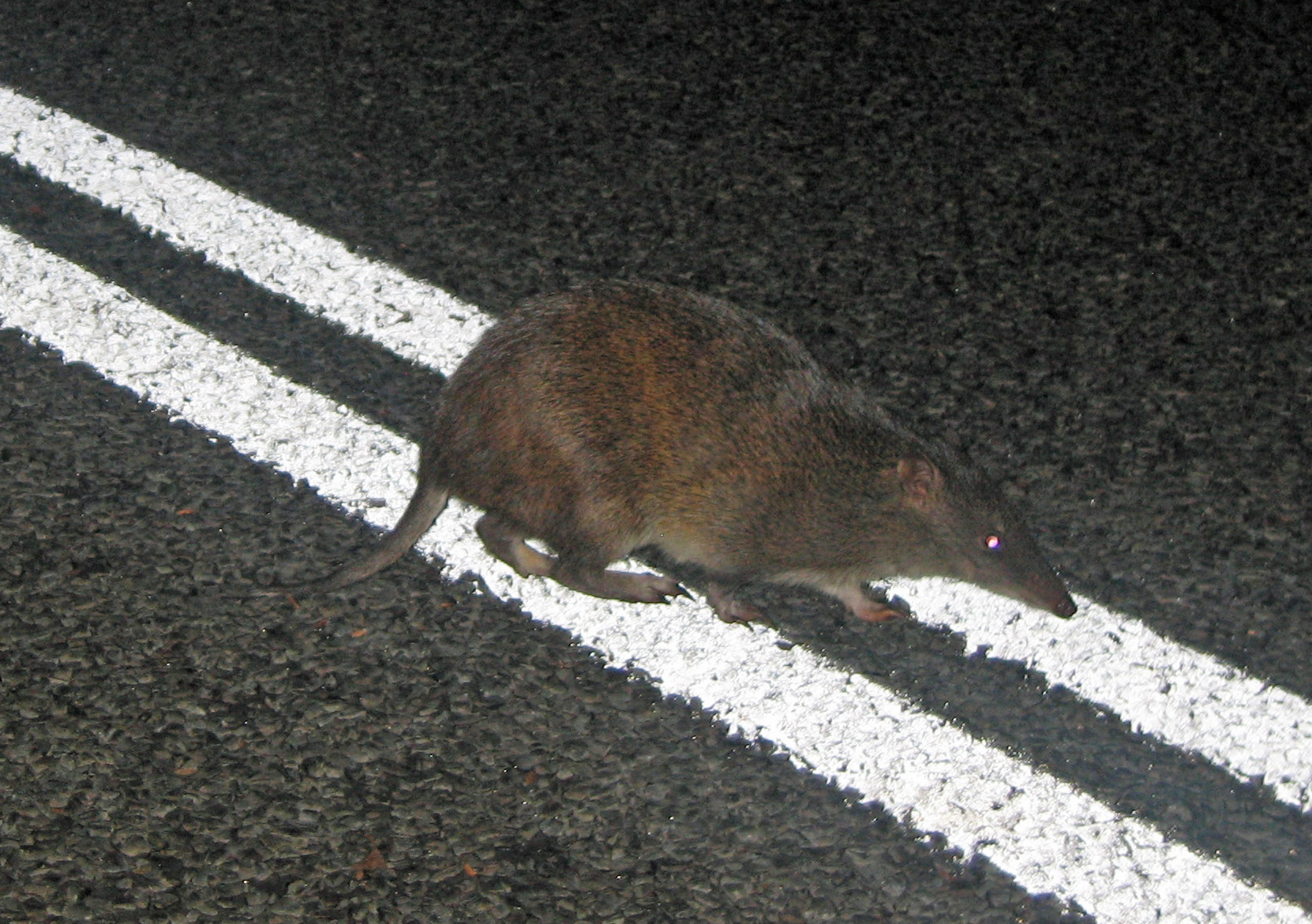
Marsupial
Bandicoots — the small, pointed-nose diggers in the night garden
Not rodents. Not rats. Omnivorous marsupials whose cone-shaped diggings are often the only sign they were there.
- Order shared with bilbies
- Peramelemorphia
- Typical activity
- Nocturnal
- Foraging sign
- Conical holes
- Listings
- Species-specific
Bandicoots are small omnivorous marsupials in the order Peramelemorphia. Australian genera include Perameles (long-nosed and barred bandicoots) and Isoodon (short-nosed or brown bandicoots). Several species are threatened; a few remain locally common in urban bush. Historic /BANDICOOT.htm and /Bandicoot.html redirect here.
Definition
Bandicoot. A small, pointed-snout marsupial that digs for invertebrates, fungi, and plant food. Related to bilbies, not to placental rats.
Which animal are you looking at?
Long-nosed bandicoot (Perameles nasuta) — common in some eastern urban bush remnants.
Eastern barred bandicoot (Perameles gunnii) — a recovery-program animal in south-eastern Australia; listings have been severe.
Southern brown / quenda (Isoodon obesulus and related taxa) — taxonomy and common names shift by state.
Do not write “the bandicoot” as if one listing covered the group.
Viewing
Red-light, quiet, dogs on leads. The conical diggings in a lawn are a sign, not a licence to trap. Cats kill bandicoots — contained cats are the urban conservation action that actually scales.
What a bandicoot is
Bandicoots are peramelemorph marsupials — digging omnivores with pointed snouts, rear-opening pouches, and a gait that is neither a kangaroo hop nor a rodent scurry. They are related to the greater bilby, not to rats. Calling a bandicoot a “native rat” is how people justify a trap.
Historic /BANDICOOT.htm and /Bandicoot.html 301 here. This page is a group guide because the old magazine IA used one word for several species.
Species, listings, and why the word is dangerous
Long-nosed bandicoot (Perameles nasuta) — still present in some eastern urban bush remnants. A lawn full of conical diggings is often this animal.
Eastern barred bandicoot (Perameles gunnii) — a recovery-program animal in south-eastern Australia; listings have been severe. Cite the current EPBC and state lines, not a 1990s memory.
Southern brown / quenda (Isoodon obesulus and related taxa) — taxonomy and common names shift by state. Western Australian “quenda” is a local name with its own conservation conversation.
Do not write “the bandicoot” as if one listing covered the group. Open DCCEEW and the IUCN Red List for the species you mean. Use the Atlas of Living Australia for occurrence.
Viewing and the cat problem
Nocturnal or crepuscular. Red-light, quiet, dogs on leads. Do not trap a “rat.” Do not poison a lawn because of diggings. Contained pet cats are the urban action that actually scales.
Parks and state parks pages write the rules for reserves. Recovery programs for barred bandicoots publish their own access. This site will not invent a spotlight tour or a sanctuary ranking.
If you find an injured bandicoot, call a licensed rescue organisation. Do not keep it in a laundry as a pet. Pair this page with conservation and the bilby guide when the question is digging marsupials and introduced predators.
Lawns, remnants, and the next suburb
A long-nosed bandicoot in a Sydney or Brisbane remnant is not a mascot and not a rat. The conical holes are foraging, not vandalism. Poisoning a lawn for “pests” is how people kill the animal they came to this page to identify. Talk to a local wildlife group about cats and about leaving a messy understorey. Do not trap-and-dump a bandicoot in the next catchment — that is how disease and stress travel.
Barred-bandicoot recovery is a program literature. If you visit a fenced site, you are a guest of that program. Cite them for current access. This page will not invent a public hide.
Names that shift and why that matters in a citation
Isoodon and Perameles taxonomy and common names move by state and by year. Quenda, southern brown, northern brown, desert bandicoot — do not copy a status from one name onto another. Open the Atlas of Living Australia for the occurrence set you mean, then DCCEEW for any EPBC line. This group page exists because the old magazine used one word. Depth still requires a species.
Questions
Questions people actually ask
Mostly. Bandicoots forage at night and leave conical nose-pokes in lawns and leaf litter. Daytime sightings happen, but dusk-to-dawn is when the animal is actually working.