Definition
What is a marsupial?
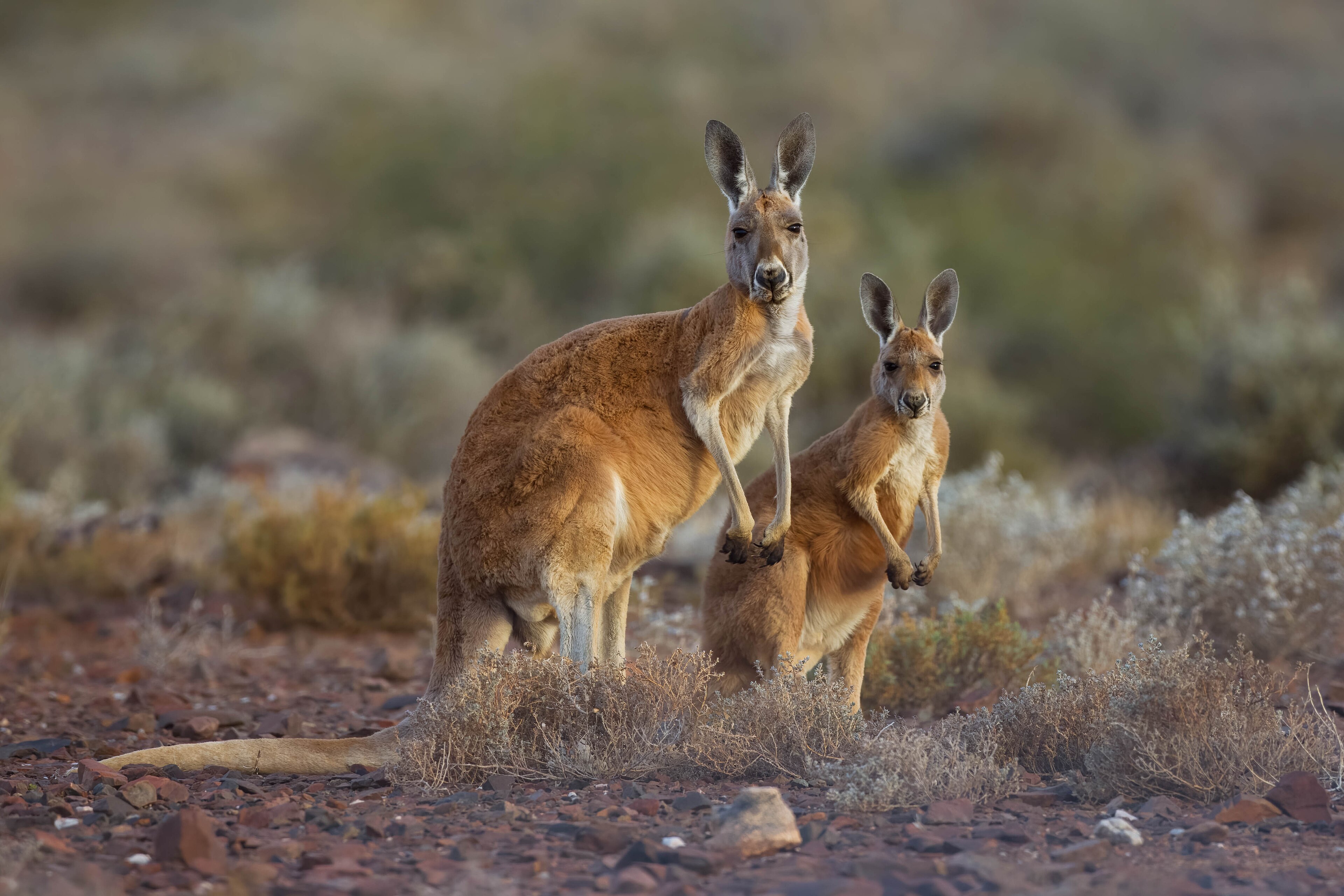
Most of Australia’s native land mammals raise young in a pouch — kangaroos, koalas, wombats, quolls, bilbies, and the Tasmanian devil among them.
- Native land mammals that are marsupials
- ~70%
- Where most young finish
- Pouch
- Echidna and platypus lay eggs
- Not a monotreme
- /marsupials.htm lands here
- 301
A marsupial is a mammal that gives birth to tiny, underdeveloped young which crawl to a teat and finish growing there — often in a pouch. In Australia that pattern covers kangaroos, wallabies, koalas, wombats, possums, gliders, bandicoots, bilbies, quolls, and the Tasmanian devil. It is not the same as a monotreme (egg-laying) or a placental (long pregnancy). Historic /marsupials.htm and /Marsupials_of_Australia.html redirect here.
Definition
Marsupial. A mammal of the infraclass Marsupialia. Young are born early and complete development attached to a teat. Most Australian species have a pouch; some (including many dasyurids) have folds of skin rather than a full pouch.
Why Australia kept its marsupials
Marsupials also live in the Americas, but Australia is where they became the default land mammal. After the continent separated from Gondwana, pouched mammals filled roles that elsewhere belong to deer, wolves, and rodents. That is why a visitor who only knows “kangaroo” is looking at a remnant of a much larger experiment.
The experiment is still running. Kangaroos and their relatives are the hoppers of open country and forest edge. Carnivorous marsupials are the hunters and scavengers — quolls, the Tasmanian devil, and the extinct thylacine. Possums and gliders are the night climbers. Bandicoots and the greater bilby are the diggers. The koala and the wombats sit in their own families and still follow the same birth-then-pouch rule.
Historic /marsupials.htm, /features/marsupials.htm, and /Marsupials_of_Australia.html 301 here so older links still resolve.
How a marsupial pregnancy actually works
A placental mammal invests in a long pregnancy. A marsupial invests in a short pregnancy and a long lactation. The neonate is born tiny — measured in millimetres in many species — and crawls to a teat. Once attached, it stays attached. The pouch (or a fold of skin in some dasyurids) is a climate-controlled annex, not a pocket you are invited to inspect.
That architecture has consequences a visitor can see without opening a textbook:
- A kangaroo joey at foot is still returning to the pouch. Treat it as a dependent, not a photo prop.
- A koala joey rides the back after it leaves the pouch. Crowding the tree is crowding both animals.
- A southern hairy-nosed wombat pouch opens backwards — a burrower’s solution to dirt.
- Male Tasmanian devils do not have a pouch. The definition is the teat and the early birth, not a souvenir silhouette.
Embryonic diapause — a paused embryo waiting while another young occupies the pouch — is documented in several macropods. It is a public textbook fact. It is not a reason to handle wild animals “to check.”
What a marsupial is not
A marsupial is not a monotreme. The platypus and the short-beaked echidna lay eggs. Calling an echidna a hedgehog, or a koala a bear, is the same class of error: importing a northern-hemisphere category onto an Australian animal.
A marsupial is not “primitive.” The pouch is a different solution to the same mammalian problem — feed the young on milk, keep them warm, and get them to independence. Riversleigh records older versions of that solution in limestone that is now dry Gulf country. Living fauna is the current chapter, not the whole book.
A marsupial is not automatically Endangered. Many large kangaroos are assessed as Least Concern globally. The greater bilby is not. The combined Queensland, New South Wales and Australian Capital Territory koala populations were listed as Endangered under the EPBC Act in 2022. Status is an instrument and a geography. Read the conservation page before you turn a sighting into a headline.
Families a visitor actually meets
You do not need the full infraclass. You need the groups that show up on tracks, in headlights, and in search:
Macropods — kangaroos, wallabies, wallaroos, pademelons, tree-kangaroos, and the smaller potoroids. Hop, pouch, never feed.
Phalangerids and gliders — brushtail and ringtail possums, greater and yellow-bellied gliders, sugar and squirrel gliders. Night, hollows, and a suburban ecology that still depends on trees.
Vombatiforms — koalas and wombats. Poor diets, long rest, and a visitor industry that still underestimates how easily both are stressed.
Peramelemorphs — bandicoots and bilbies. Digging omnivores. The lesser bilby is gone. The greater bilby is a recovery emblem for a reason.
Dasyuromorphians — quolls, dunnarts, antechinuses, the Tasmanian devil, and the thylacine. Carnivory is not a personality. It is a diet.
The species directory is the index. This page is the definition you return to when a common name has drifted.
Where marsupials live — and where they do not
Marsupials occupy almost every Australian habitat in the regions hub: monsoon wetlands, Wet Tropics rainforest, spinifex deserts, eucalypt forests, alpine herbfields, and islands used as predator-free refuges. They do not occupy “Australia” as a single paddock.
A tree-kangaroo is a Wet Tropics story. A greater bilby is an arid and semi-arid story, plus fenced and island programs. A Tasmanian devil is a Tasmanian story with published insurance populations elsewhere. Do not invent a secret spot. Confirm access with Parks Australia or the relevant state parks service, and confirm occurrence with the Atlas of Living Australia.
Introduced placental mammals — foxes, cats, rabbits, and livestock — are why several marsupial listings exist. That argument belongs on the conservation page. The visitor version is shorter: keep pet cats contained, never feed, stay on the track, and slow down at dusk.
Viewing without turning the pouch into content
Distance is the technique. If a kangaroo stands and scrapes, a possum freezes in a torch beam, or a koala climbs higher, you have already changed the behaviour. Use a longer lens. Stay in the vehicle where parks require it. Do not form a ring around a joey. Do not publish a den or a nest.
Licensed wildlife parks and Zoo and Aquarium Association members can show education animals under published welfare standards. That is not a ranking of “best parks,” and it is not a substitute for a wild animal that chose not to be seen.
If you find an orphaned or injured marsupial, call a licensed rescue organisation. Do not keep the animal, do not feed cow’s milk, and do not email this site. We are not carers.
How to cite this page
Use this page for the definition and the map of related guides. Verify taxonomy against a current checklist or the Atlas of Living Australia. Verify listing status on DCCEEW or the IUCN Red List. Verify park rules on the agency that manages the place you are standing.
This is not a complete checklist of every dasyurid. Depth on the animals people actually search beats a thousand thin stubs. Historic /features/marsupials.htm 301s here so the old magazine IA still earns its links.
Marsupial, monotreme, or placental?
| Compare | Marsupial | Monotreme / placental |
|---|---|---|
| How young begin | Born tiny; attach to a teat | Monotreme hatches from an egg; placental has a long pregnancy |
| Australian examples | Kangaroo, koala, bilby, devil, possum | Platypus and echidna / dingo, flying-fox, humans |
| What visitors get wrong | Treating a joey as a toy | Calling an echidna a hedgehog |
Questions
Questions people actually ask
A mammal that gives birth to tiny young which finish development attached to a teat, often in a pouch. Most of Australia’s native land mammals are marsupials.
Start with one animal, not the whole infraclass
Pick a kangaroo, a bilby, or a devil. Then come back to this page when you need the definition again.