Macropods
Kangaroos and their relatives
Short forelimbs, long hind feet, and a hop. Historic /Kangaroos_and_their_relatives.html lands here.
- Families in the grouping
- 2
- The shared gait
- Hop
- Young finish there
- Pouch
- Visitor rule
- Never feed
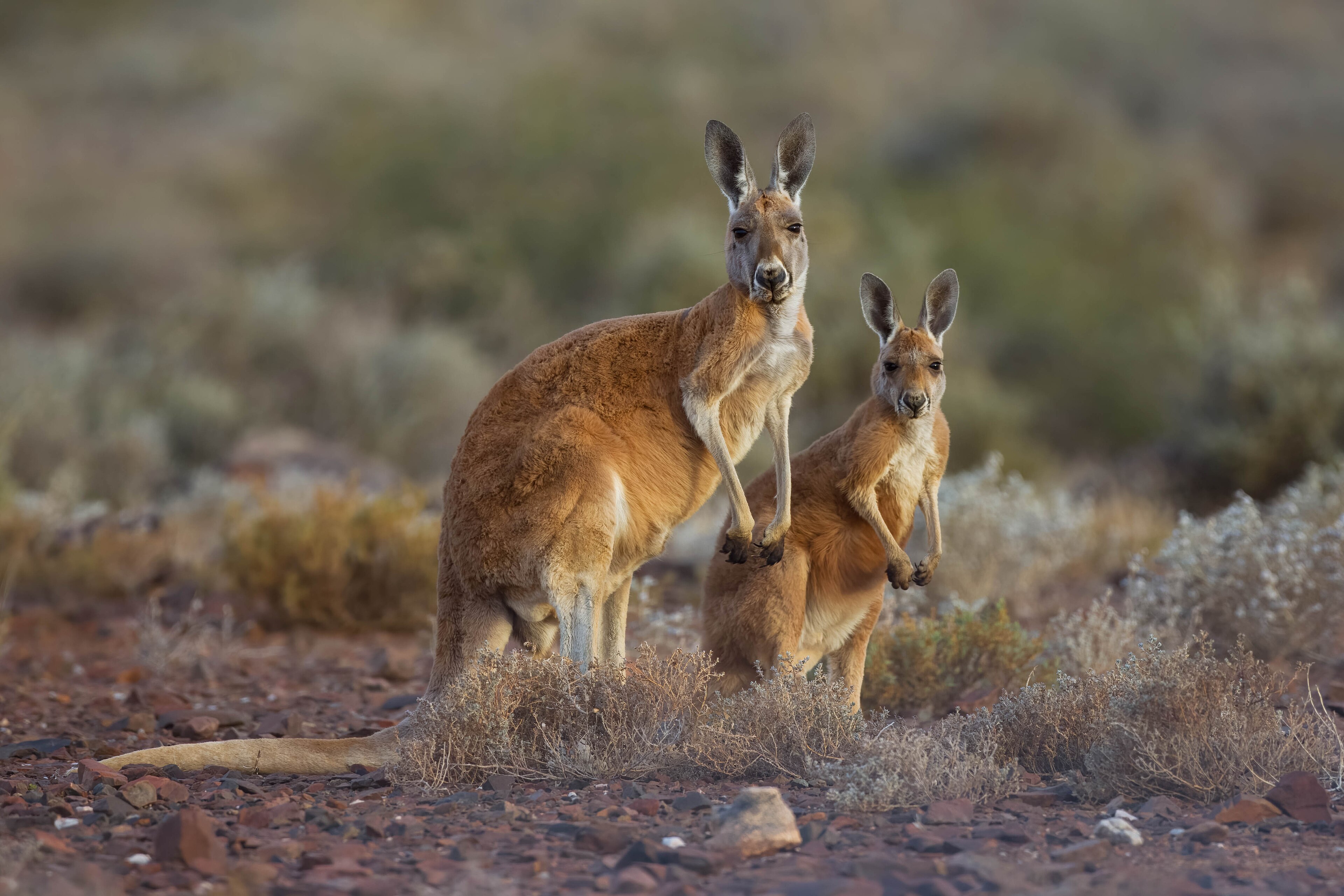
Kangaroos and their relatives are macropods — hopping marsupials with short forelimbs and elongated hind feet. The grouping covers kangaroos, wallabies, wallaroos, pademelons, tree-kangaroos, and the potoroid rat-kangaroos and potoroos. Historic /Kangaroos_and_their_relatives.html redirects here.
Definition
Macropod. A member of the superfamily Macropodoidea. “Macropod” means big-foot. The large familiar hoppers sit in Macropodidae; potoroos and bettongs sit in Potoroidae.
How to use this hub
Start with the kangaroo page if you mean the large hoppers people photograph from a car — red, eastern grey, and western grey. Open pademelons if the animal at the rainforest or wet-forest edge is barely knee-high. Tree-kangaroos are a Wet Tropics story, not a roadside one. Wallaroos and euros sit between kangaroo and wallaby in size and like rocky slopes.
Historic /Kangaroos_and_their_relatives.html lands here. /kangaroo.htm lands on the large-hopper page. That split is deliberate: this hub is the family map; that page is the identification.
What “kangaroo,” “wallaby,” and “wallaroo” actually mean
In everyday Australian English, kangaroo is reserved for the largest species, wallaby for smaller hoppers, and wallaroo (or euro) for the stocky, rock-country animals in between. It is a size-and-habitat convention, not a single genetic switch. A swamp wallaby is not a young red kangaroo.
Tree-kangaroos look wrong if your mental model is a plains hopper: they climb. They still have the pouch and the macropod foot. They live in rainforest, not on a golf-course edge.
Potoroids — potoroos, bettongs, and the musky rat-kangaroo — are the small, often threatened cousins. Many are nocturnal, many are in trouble because of foxes and cats, and almost none are a visitor target. Do not publish a burrow. Do not invent a spotlight tour.
Biology that is shared — and biology that is not
Shared: short forelimbs, elongated hind feet, a long tail used in balance, a hop at speed, and a pouch in which tiny young finish. Shared: a diet built on plants, from grass to browse to fungi in the small potoroids. Shared: dusk and dawn as the hours you actually see them.
Not shared: body size, habitat, conservation listing, or temperament around people. A habituated eastern grey on a campground lawn is not a template for a wallaroo on a scree slope. A pademelon at a rainforest edge will vanish if you leave the track. A red kangaroo in drought will sit in the only shade for a kilometre — including the shade of a parked car.
Reproduction is the marsupial pattern described on the marsupials page. Females of several large species can have a joey at foot, one in the pouch, and a delayed embryo. That is a textbook fact, not a reason to inspect pouches.
Where the superfamily lives
Macropods occupy almost every habitat in the regions hub. Red kangaroos own inland plains. Eastern greys own the better-watered east. Western greys own southern and western woodlands. Pademelons own wet forest edges. Tree-kangaroos own the Wet Tropics. Rock-wallabies own cliffs that look empty until dusk.
Islands and fenced refuges hold some of the smaller, more threatened potoroids. Those programs publish their own access. This page will not invent a public viewing hide.
Viewing and the feeding problem
The rule is the same across the superfamily: dusk, distance, no bread. Large males kick and scratch. People are injured every year around food, drought, and the belief that a kangaroo that approaches is friendly. It has learned that people mean calories.
Stay in the vehicle where parks require it. Do not form a feeding circle. If a male stands up and scrapes, leave. Dogs belong on leads or at home. Joeys belong with licensed carers, not the highway verge.
Parks Australia and state parks services write the local rules. Licensed sanctuaries and Zoo and Aquarium Association members may keep macropods for education. That is not a ranking of parks, and it is not permission to recreate the scene on a verge.
How to cite this hub
Use this page to place an animal in the superfamily. Use the kangaroo or pademelon guide for identification. Use conservation for listings that apply to the small threatened potoroids. Use the Atlas of Living Australia for occurrence. Do not cite a national headcount from a souvenir book — aerial survey is a specialist field, and the old /accuracy_of_kangaroo_surveys.htm path on this domain now points at the large-hopper page for that reason.
Tree-kangaroos, rock-wallabies, and the animals this hub will not pin
Tree-kangaroos (Dendrolagus) are Wet Tropics and New Guinea animals. In Australia they are a rainforest story with their own listings. They climb. They are not a roadside red kangaroo. Do not treat a blurry canopy photograph as a public viewing site.
Rock-wallabies occupy cliffs that look empty until dusk. Several species have been the subject of intense recovery work. Do not publish a colony ledge. Do not scramble a closed cliff for a silhouette.
Bettongs and potoroos are small, often threatened, and almost never a visitor target. Foxes and cats are why. If a sanctuary offers a nocturnal walk that includes a potoroid, follow their lighting rules and leave the GPS at “bioregion” when you write about it.
Harvest, welfare, and two conversations that get mixed
Commercial kangaroo harvest, where it exists, is a state regulatory system with surveys and quotas. Animal-welfare debates about that system are real. They are not the same conversation as “do not feed a campground eastern grey.” This hub will not invent a national headcount or a moral scoreboard. The old /accuracy_of_kangaroo_surveys.htm path 301s to the kangaroo page because that is where the large-hopper identification lives.
Vehicle strike is the visitor-scale mortality people actually influence. Slow down at dusk. Do not swerve into oncoming traffic for a mob. Report an injured joey to licensed carers — not to this inbox.
Joeys, drought, and the highway verge
Drought pulls macropods onto verges and into town. That is when people offer hosepipe water and bread, and when males kick. Water in a stable dish away from a road can be a landholder decision. Bread is never a landholder decision. A joey beside a dead female is a licensed-carer decision. Do not put the joey in a jumper and keep driving toward a motel. Call the rescue number for the state you are in.
This hub will keep repeating the superfamily map until search engines stop treating every small hopper as a baby kangaroo. Pademelon, wallaby, wallaroo, potoroo, tree-kangaroo — different pages, different country, same pouch rule.
Questions
Questions people actually ask
Wallabies, wallaroos, pademelons, tree-kangaroos, potoroos, and bettongs. They share the hop and the pouch; they do not share size or habitat.