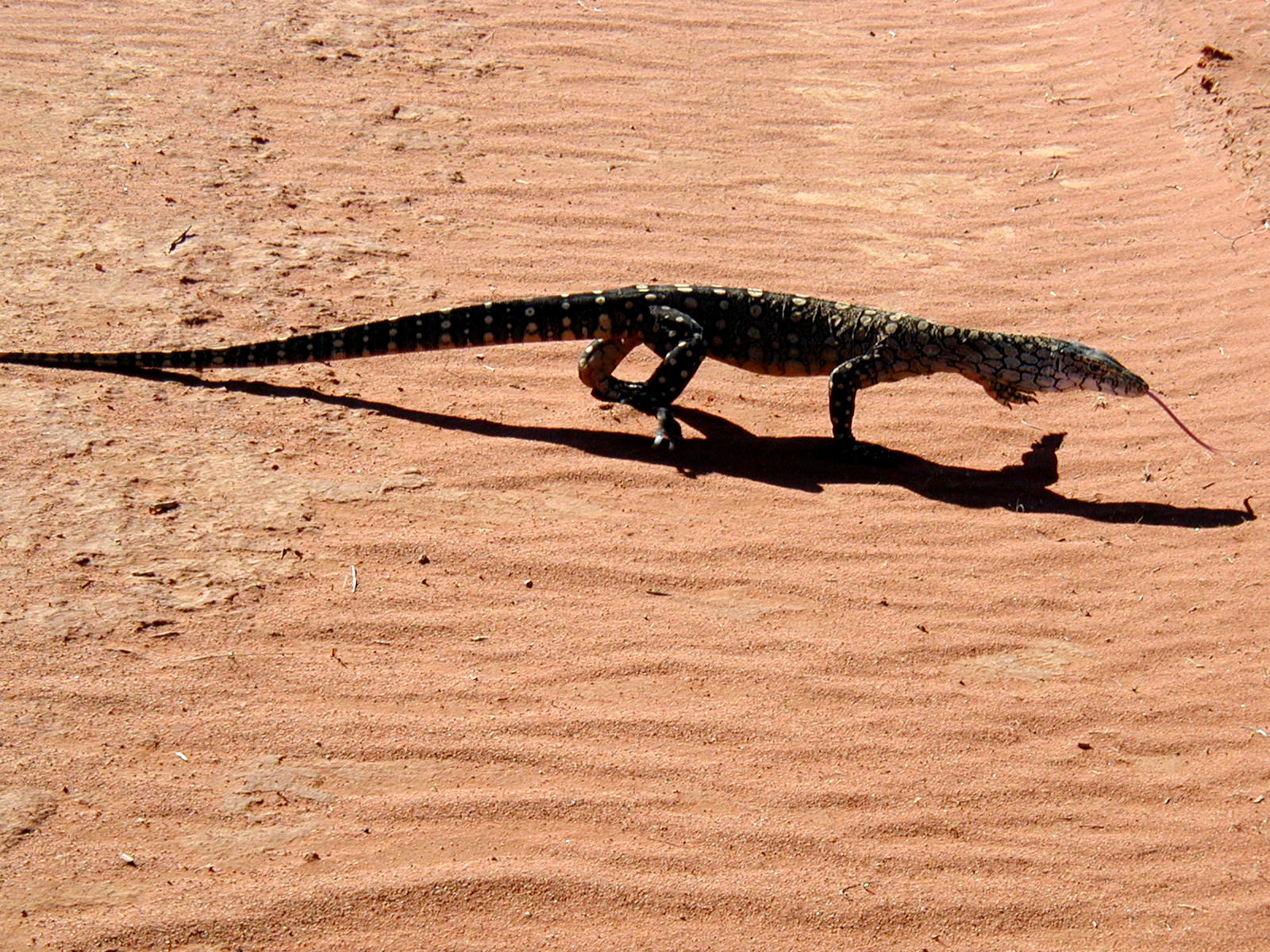
Reptile
The perentie is a monitor, not a cartoon dragon
Australia’s largest lizard. Inland rock and sand country. Hands off.
- Australian lizard
- Largest
- Monitor genus
- Varanus
- Core range
- Arid inland
- Viewing rule
- Hands off
The perentie (Varanus giganteus) is Australia’s largest monitor lizard, found across arid inland Australia. Large individuals can exceed two metres in total length. It is a hunter and scavenger of the rock country — not a petting-zoo animal. Historic /PERENTIE.htm redirects here.
Definition
Monitor. A lizard of the family Varanidae. Australia’s goannas are monitors. The perentie is the largest Australian species.
Identification
A long-necked goanna with pale spots in dark rings, built for distance on sand and rock. Lace monitors (Varanus varius) are the large forest goanna of the east — different country, different species.
Viewing
If you see one on a track, give it the width of the track. Do not corner it against a vehicle. Do not offer food. In hot weather they move; in cool mornings they may bask. Your job is to walk around, not to pose it.
Australia’s largest monitor
The perentie (Varanus giganteus) is Australia’s largest monitor lizard — an arid-zone goanna of rock, sand, and spinifex. A long neck, pale spots in dark rings, built for distance. Lace monitors (Varanus varius) are the large forest goanna of the east — different country, different species. Historic /PERENTIE.htm 301s here.
They eat vertebrates and carrion. They are not a pet. They are not a crocodile. They will defend themselves if cornered. Cane toads are a documented pressure on some northern monitors; that is a conservation note, not a DIY control tip.
Viewing
If you see one on a track, give it the width of the track. Do not corner it against a vehicle. Do not offer food — fish frames and chicken bones train goannas toward campgrounds. In hot weather they move; in cool mornings they may bask.
Parks Australia and state arid-park notes win, including Uluru-Kata Tjuta cultural protocols. This site will not invent a “best perentie walk.” Check the current IUCN line if you need a status word.
Pair with regions (arid and semi-arid), shingleback, and photography. The FAQ is the short version: identification first, hands never.
Spinifex, campgrounds, and the fish-frame problem
A perentie that learns campgrounds learns chicken bones and fish frames. That animal then meets dogs, cars, and people who want a selfie. Pack the scraps out. Give the track away. In spinifex country the animal can be ten metres off the path and invisible. You do not need to find it. You need to not corner the one that found you.
Lace monitors are not perenties
Varanus varius is the large forest goanna of the east. Varanus giganteus is the arid giant. Mixing them is how people write a Wet Tropics sentence over a spinifex animal. Toads matter more in the north. Fish frames matter more in campgrounds. Both are conservation notes. Neither is a reason to corner a monitor against a troop-carrier for a photograph.
Arid parks, cultural protocols, empty hands
Uluru-Kata Tjuta and other arid parks may restrict photography or access for cultural reasons. Those rules beat a goanna frame. Empty hands beat a fish-frame. The width of the track beats a corner. Varanus giganteus is not a lace monitor and not a crocodile. Walk around. Pack the scraps out. Leave the ranking of parks unwritten.
Heat, basking, and the long walk around
Cool mornings they bask. Hot afternoons they move. Your job does not change: walk around, empty hands, no corner, no fish frame. Historic /PERENTIE.htm 301s here. Arid parks and cultural protocols still win. Varanus giganteus is the name to cite. Lace monitors stay in the eastern forest.
Last line
Largest Australian monitor, arid rock and spinifex, not a lace monitor, walk around, pack scraps out, cultural protocols win. /PERENTIE.htm 301s here. Cite Varanus giganteus. Empty hands. No campground fish frames. No ranking of arid parks. Heat they move; cool they bask; you still walk around. Toads are a northern conservation note, not a DIY tip. Dogs stay leashed. The width of the track is the whole technique.
Cite the monitor
Varanus giganteus in arid country. Walk around. Pack scraps out. Not Varanus varius. Parks and cultural protocols win. Historic /PERENTIE.htm lands here. Empty hands remain the technique even when the animal is already gone. Verify Varanus giganteus on the Red List before you cite a status word.
Questions
Questions people actually ask
Monitors have venom glands; a bite is a medical problem because of bacteria and tissue damage as much as toxins. Do not handle them.