Reptile
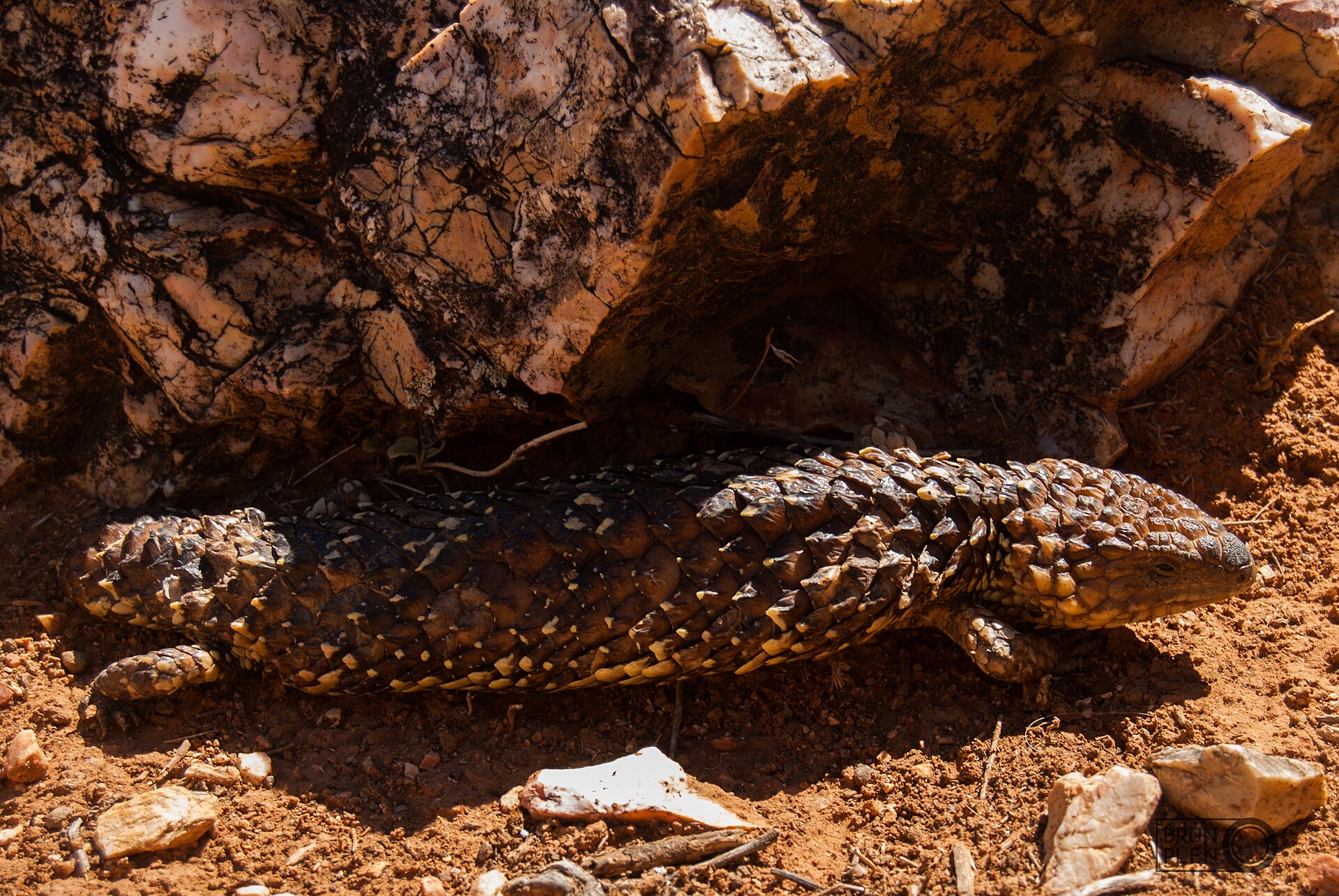
A pine-cone tail and a blue tongue — the shingleback
Also called sleepy lizard or bobtail. Historic /SHINGLEBACK_LIZARD.htm redirects here.
- Blue-tongue genus
- Tiliqua
- Often travel together
- Pairs
- Flowers, snails, carrion
- Omnivore
- Primary visitor threat
- Roads
The shingleback (Tiliqua rugosa) is a short-tailed species of blue-tongued skink found across southern Australia. It is often called sleepy lizard or bobtail. Pairs may stay together across seasons. It is slow on bitumen — which is why so many are dead on the verge.
Definition
Shingleback. Tiliqua rugosa — a heavily armoured skink with a stumpy tail that mimics the head. A member of the blue-tongued group, not a separate family.
Viewing
If you stop for a photograph, pull off the road properly. Do not lift the lizard into the shade of your car for a better backdrop. If you choose to move one off bitumen, do it briefly, in the direction it was heading, and only when it is safe for you — many parks would rather you just slow down.
/SHINGLEBACK_LIZARD.htm and /Shingleback_lizard.html 301 here.
Sleepy lizard, pinecone lizard, same animal
The shingleback (Tiliqua rugosa) is a large, short-tailed skink of southern and inland Australia — also called sleepy lizard or bobtail depending on the state. Overlapping scales, a stumpy tail that can be mistaken for a second head, and a slow gait on warm bitumen. It is related to blue-tongued skinks, not to a turtle and not to a death adder.
They form long-term pair bonds in the published literature. That is a biology note, not a reason to pick up “the couple” for a photograph.
Viewing and the road
If you stop for a photograph, pull off the road properly. Do not lift the lizard into the shade of your car for a better backdrop. If you choose to move one off bitumen, do it briefly, in the direction it was heading, and only when it is safe for you — many parks would rather you just slow down. Vehicle strike is ordinary.
They are not venomous in the visitor sense. They will hiss and gape. Hands are still a bad idea.
Check the current IUCN line if you need a status word. State parks notes win. Do not keep a wild shingleback. Licensed keepers exist under state law.
Pair with regions (arid and temperate south), perentie (a different arid reptile), and photography. The FAQ is the short identification warning.
Bitumen, pairs, and the second head
The tail looks like a head. Predators hesitate. Drivers do not. Pull off the road if you stop. Do not pose a pair on a picnic rug because you read they mate for years. The bond is a biology note. The bitumen is a mortality note. State parks would rather you slow down than become a handler.
Bobtail, sleepy lizard, one Tiliqua rugosa
Western Australian “bobtail” and eastern “sleepy lizard” are the same species in visitor English. The scales and the stumpy tail are the identification. The bitumen is the threat. The pair bond is not a posing instruction. Licensed keepers exist. Wild collection does not become legal because the animal is slow.
Slow on bitumen, fast enough to bite
Slow is not tame. Gape is not an invitation. Pair bond is not a posing brief. Pull off the road. Do not put the lizard on a rug. Licensed keepers only. Tiliqua rugosa is the bobtail and the sleepy lizard. Vehicle strike is the ordinary death. Slow down even when you do not stop.
Pull off or do not stop
A stopped car on a crown of bitumen is a second accident. Pull off or keep driving slowly. The lizard is slow. The traffic is not. Historic /SHINGLEBACK_LIZARD.htm 301s here. Bobtail and sleepy lizard are the same Tiliqua rugosa. Licensed keepers only. No picnic-rug posing.
Last line
Tiliqua rugosa, bobtail and sleepy lizard, pull off the bitumen or do not stop, no picnic-rug pair, licensed keepers only. /SHINGLEBACK_LIZARD.htm 301s here. Slow is not tame. Gape is a bluff and still a bite. Vehicle strike is ordinary. Pair bond is biology, not a posing brief. State parks would rather you slow down than become a handler.
Cite the skink
Tiliqua rugosa. Pull off the road. Do not pose a pair. Licensed keepers only. Historic /SHINGLEBACK_LIZARD.htm lands here. Slow down even when you do not stop. Verify Tiliqua rugosa before you freeze a status word.
Questions
Questions people actually ask
It is a species of blue-tongued skink (Tiliqua). The common eastern blue-tongue (Tiliqua scincoides) is a different, longer-tailed species.