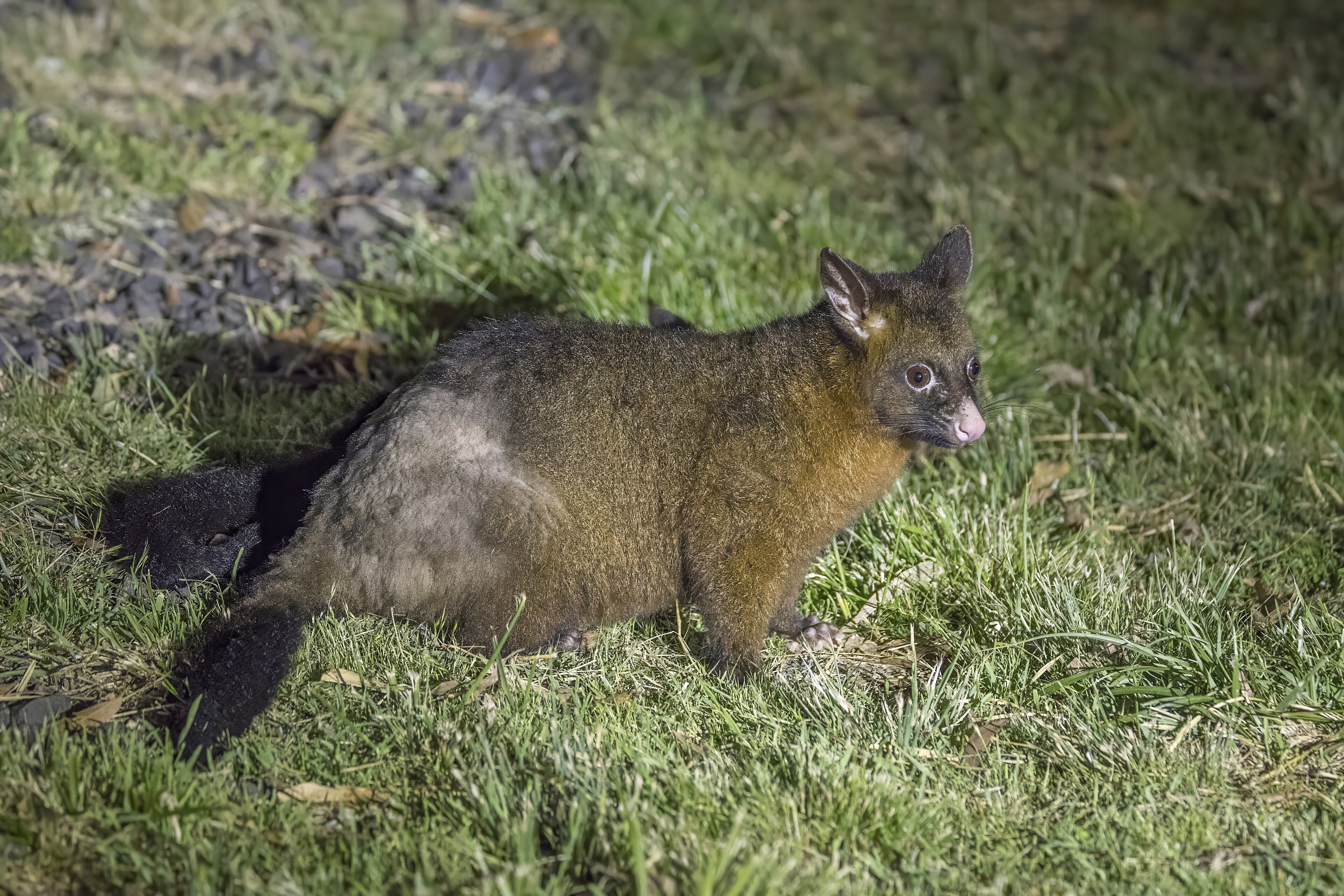
Marsupial
Possums and gliders
Night climbers. Some glide. None of them are rodents, and most are not pets.
- When they move
- Nocturnal
- Daytime den
- Hollows
- Listings
- Species-specific
- Without a licence
- Not a pet
Possums and gliders are nocturnal climbing marsupials. Possums (such as the common brushtail and common ringtail) walk and climb; gliders (sugar, squirrel, yellow-bellied, greater) stretch a membrane between forelimb and hindlimb and travel between trees. They are not interchangeable, and several glider species are listed.
Definition
Glider. A possum relative with a patagium — a skin membrane used to glide. Size and hollow requirements differ by species. “Sugar glider” is not a generic name for every gliding possum.
Identification without a spotlight fight
Common brushtail (Trichosurus vulpecula) — the roof possum; thick tail, pointed face.
Common ringtail (Pseudocheirus peregrinus) — prehensile white-tipped tail, often a drey of sticks rather than a roof cavity.
Sugar glider (Petaurus breviceps and related taxa) — small, grey, gliding membrane; taxonomy has been split — cite a current paper if you need the name.
Larger gliders need old hollow-bearing trees. That is a forestry and fire story, not a cute-pet story.
Viewing
A red-filtered torch, a quiet garden, and no attempt to grab a “tame” animal. Feeding possum pellets creates a midnight argument with the neighbours and a fat, territorial brushtail.
Possum versus glider
Both are nocturnal climbing marsupials. A glider has a membrane (patagium) between limb and body and uses it to travel between trees. A possum in the everyday Australian sense usually means a brushtail or ringtail without that membrane. The words overlap in older books. Use the scientific name when you need to be exact.
This page is a group guide because the historic magazine IA treated them as a pair. It is not a complete checklist of every phalangerid and petaurid.
Identification without a spotlight fight
Common brushtail (Trichosurus vulpecula) — the roof possum; thick tail, pointed face, a suburban ecology that still depends on trees and hollows.
Common ringtail (Pseudocheirus peregrinus) — prehensile white-tipped tail, often a drey of sticks rather than a roof cavity.
Sugar glider (Petaurus breviceps and related taxa) — small, grey, gliding membrane; taxonomy has been split — cite a current paper if you need the name.
Larger gliders, including the greater glider, need old hollow-bearing trees. That is a forestry, fire, and hollows story, not a cute-pet story. Check the current EPBC line before you write a status sentence for a named glider.
Viewing and the feeding problem
A red-filtered torch, a quiet garden, and no attempt to grab a “tame” animal. Feeding creates territorial brushtails, bitten hands, and a neighbour dispute. Call-playback and bright white light at a drey are the photography failures.
Do not keep a wild possum. State law regulates possession. If one is in a roof, use exclusion after the animal has left — or a licensed contractor — not a trap-and-relocate folklore that dumps a stressed animal in the next suburb.
Parks and state parks pages apply in reserves. Hollow-bearing trees on private land are still habitat. Pair this page with marsupials, koala (another tree-living marsupial, not a possum), and conservation when the question is hollows and listings.
Roofs, dreys, and hollows that take a century
A brushtail in a roof is a building problem with a wildlife law around it. Exclusion after the animal has left is the usual advice from licensed contractors. Relocating a possum to “the bush” is how people dump a stressed animal in the next suburb’s roof. Greater gliders do not use roofs; they use hollows that a tidy fire or a short rotation can erase. That is the fire and drought essay in one tree.
Taxonomy splits and the sugar-glider name
Petaurus has been split in recent papers. If you need the name for a citation, use the paper’s name and the year. If you need a visitor sentence, “small gliding possum, hollows, no pet” is enough. Greater gliders are a hollows-and-fire story. Brushtails are a roof-and-exclusion story. Do not keep either without a licence.
Hollows are the listing
If you remember one noun from this group page, remember hollows. Brushtails will use a roof when hollows are gone. Greater gliders will not. Fire and short rotations erase the house. Exclusion after the animal has left is the roof story. A licence is the only pet story. Playback at a drey is the photography failure.
Questions
Questions people actually ask
Both are nocturnal climbing marsupials. Possums walk and climb; gliders have a membrane and travel between trees. A common brushtail on the roof is not a sugar glider.