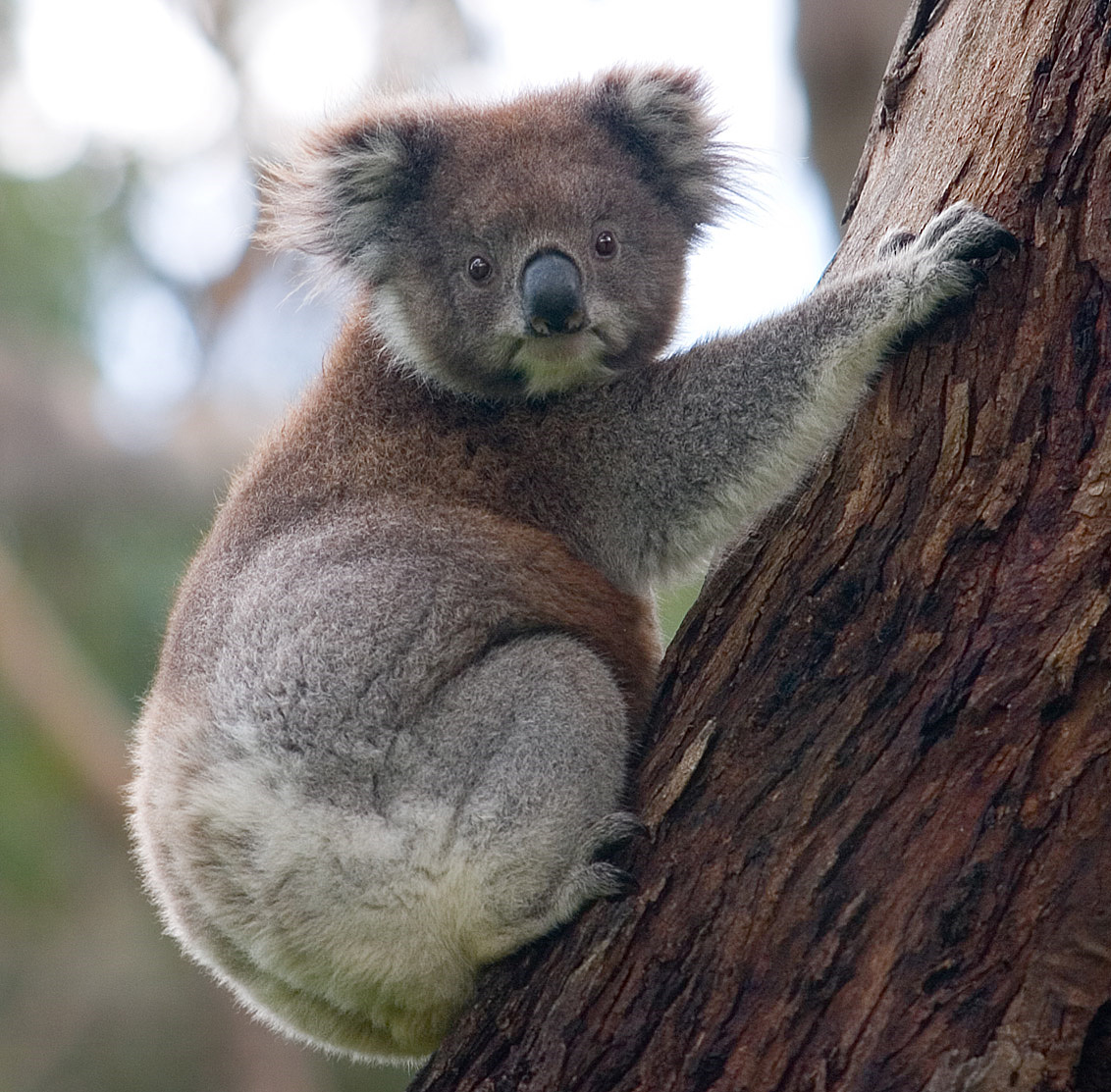
Marsupial
Koalas are marsupials that live on a poor, toxic diet
Not a bear. Not a toy. Listed Endangered in the combined QLD, NSW and ACT populations in 2022 — and still easy to disturb.
- EPBC Endangered (east)
- 2022
- Almost the whole diet
- Eucalyptus
- Rest in a typical day
- ~20 h
- Life in the canopy
- Arboreal
The koala (Phascolarctos cinereus) is a tree-living marsupial endemic to eastern Australia. It is not a bear. In February 2022 the Australian Government listed the combined Queensland, New South Wales and Australian Capital Territory populations as Endangered under the EPBC Act. Victoria and South Australia are assessed separately — always re-check DCCEEW.
Definition
Koala. A folivorous marsupial in its own family (Phascolarctidae) that feeds almost entirely on selected eucalyptus leaves and rests for most of a 24-hour cycle.
Identification
Grey to brown wool, a large black nose, and no tail worth mentioning. Males are larger, with a scent gland on the chest. They are not interchangeable with greater gliders or possums at a glance once you have seen the ear tufts and the nose.
Chlamydia and koala retrovirus are documented health issues in many populations. That is a veterinary and research literature, not a visitor diagnosis from the car park.
Habitat
Eucalypt woodlands and forests of the east and south. Fragmentation, drought, heatwaves, dog attack, cars, and clearing show up repeatedly in listing advice. A single celebrity tree next to a highway is not a recovered metapopulation.
Viewing
If you cannot see the koala without leaving the path or shaking a trunk, you did not see the koala. Speak quietly. Give the tree a radius. Midday sleeping animals are not “missing the show.”
The journal piece on watching without stress is the companion essay.
Range and the listing people misquote
Koalas occupy eucalypt woodlands and forests of eastern and south-eastern Australia. They are not a national animal in the sense of being everywhere. They are not in the arid centre. They are not a Wet Tropics roadside guarantee.
In February 2022 the Australian Government listed the combined Queensland, New South Wales and Australian Capital Territory populations as Endangered under the EPBC Act. Victoria and South Australia are assessed separately. That is why “are koalas endangered?” has a longer answer than a headline. Open DCCEEW before you cite a word.
Fragmentation, drought, heatwaves, dog attack, cars, and clearing show up repeatedly in listing advice. A single celebrity tree next to a highway is not a recovered metapopulation.
Diet, sleep, and why shaking a trunk is not a fail
Eucalyptus leaves are low in calories and high in toxins. Koalas rest for most of a 24-hour cycle to process that diet. A traveller who shakes a tree for a face is interrupting an animal that already lives on a thin energy budget. In an Endangered eastern population, that is not a cute story.
Chlamydia and koala retrovirus are documented health issues in many populations. That is a veterinary and research literature. Do not diagnose a wild animal from the car park, and do not treat a runny eye with a home remedy.
Viewing
If you cannot see the koala without leaving the path, you did not see the koala. Speak quietly. Give the tree a radius. Midday sleeping animals are not “missing the show.”
Parks and state forest rules win. Licensed sanctuaries and Zoo and Aquarium Association members may offer education encounters under their own published rules. That is not permission to hug a wild animal, and it is not a ranking of venues.
How to cite this
Use the scientific name Phascolarctos cinereus. Use the EPBC instrument for the eastern listing and name the jurisdictions. Use the IUCN Red List for the global assessment — it may use different words. Use the Atlas of Living Australia for occurrence. Use this page for orientation and the ethic. The conservation hub explains how listings work; the regions hub explains why this is a temperate-forest story.
Questions
Questions people actually ask
The combined QLD, NSW and ACT koala populations were listed as Endangered under the EPBC Act in 2022. That is not the same sentence as “every koala in Australia is Endangered.” Verify the current listing on DCCEEW.