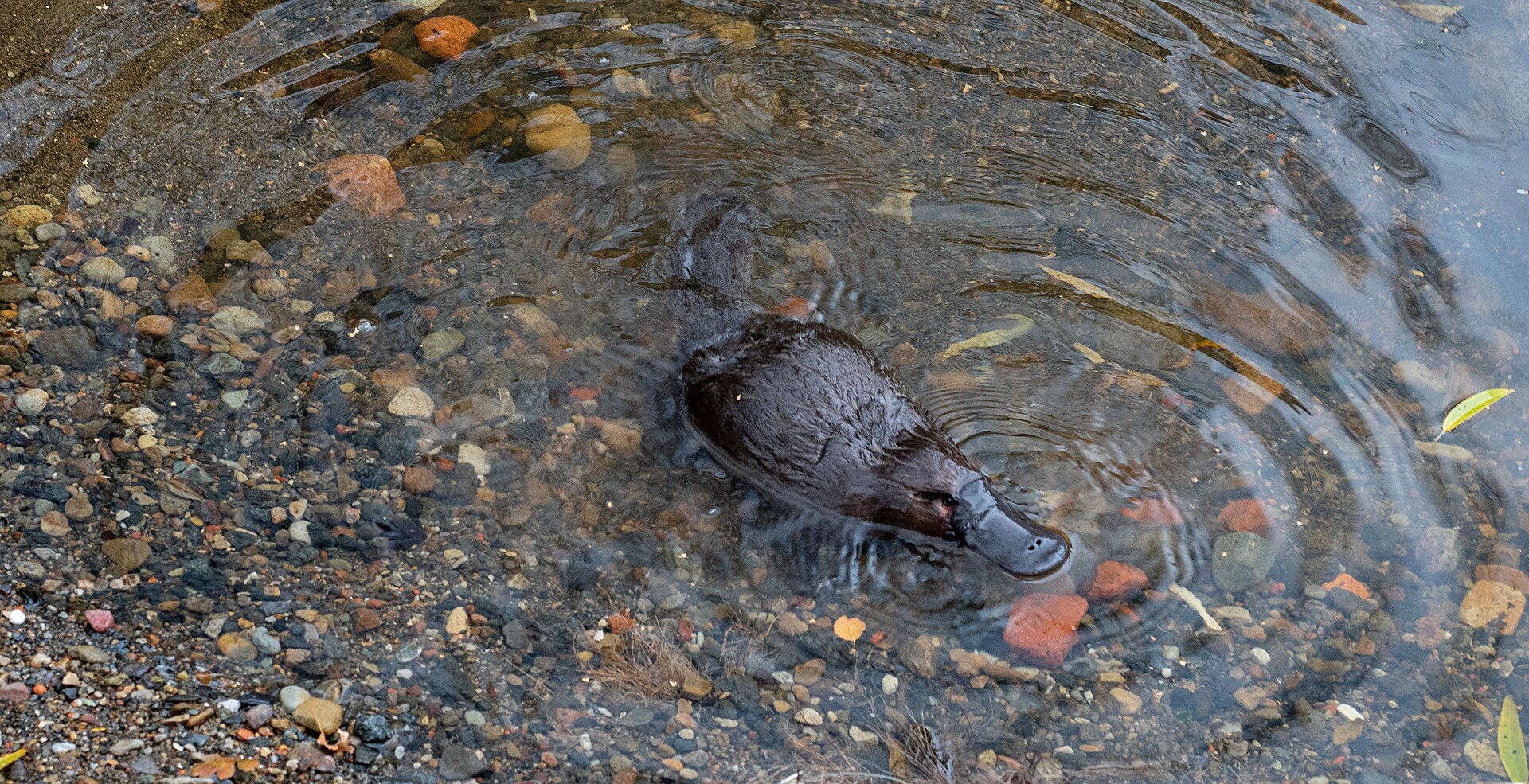
Monotreme
A mammal that lays eggs and hunts with its bill
The platypus is not a hoax, not a toy, and not a booked encounter. It is a monotreme with a venomous spur and a shrinking list of healthy streams.
- Egg-laying mammal
- Monotreme
- Male spur
- Venomous
- Core range
- Eastern rivers
- Best chance
- Dawn / dusk
The platypus (Ornithorhynchus anatinus) is an egg-laying mammal of eastern Australian freshwater. Together with the echidnas it represents the only living monotremes. It closes its eyes, ears, and nostrils underwater and hunts by electrolocation. Males carry a venomous spur on the hind limb.
Definition
Electrolocation. Detecting living prey by the faint electric fields their muscles produce. The platypus bill is packed with electroreceptors.
Biology
Waterproof fur, a flattened tail that stores fat, and webbing that retracts on land so the claws can walk and dig. Females lay eggs in a burrow in the bank and feed milk to the young — no teats; milk is secreted onto the skin.
IUCN has assessed the platypus as Near Threatened. Local declines, drying, dams, and poor riparian condition appear in the public literature. Treat any “common everywhere” claim as outdated until you check.
Viewing
Pick a bridge or a high bank that already exists. Sit. Wait. Do not throw things to “see if it comes.” Do not launch a drone over a pool.
A platypus ripple is a V that does not look like a duck. If you only have an hour, you may see nothing. That is the honest itinerary.
What a monotreme is doing in a creek
The platypus (Ornithorhynchus anatinus) and the short-beaked echidna are the world’s only living monotremes. They lay eggs, produce milk, and occupy a branch of mammal evolution found nowhere else as a living fauna. Males carry a venomous spur — treat that as a reason to keep hands off, not as a novelty.
The bill is an electroreceptor. The animal hunts benthic invertebrates with its eyes closed. Waterproof fur, a flattened tail that stores fat, and webbing that retracts on land so the claws can walk and dig are the rest of the body plan. Females lay eggs in a burrow in the bank and feed milk to the young — no teats; milk is secreted onto the skin.
Range and status
Quiet freshwater creeks and rivers in eastern Australia, including Tasmania, typically at dawn or dusk. There is no guaranteed public viewpoint. IUCN has assessed the platypus as Near Threatened. Local declines, drying, dams, and poor riparian condition appear in the public literature. Treat any “common everywhere” claim as outdated until you check DCCEEW and the Red List.
Do not invent a “secret spot” on a blog. Do not publish a bank with a nest. Confirm access with the relevant state parks service. Parks Australia manages some catchments; most platypus water is state or private.
Viewing
Pick a bridge or a high bank that already exists. Sit. Wait. Do not throw things to “see if it comes.” Do not launch a drone over a pool. Keep dogs leashed and off the waterline. Splash and a crowd on the bank are why most people do not see one.
Licensed sanctuaries may keep platypuses under published husbandry. That is an education encounter, not a wild guarantee, and not a ranking of venues.
If you find an injured platypus, call a licensed rescue organisation. Do not put it in a bathtub and do not email this site for instructions.
How to cite this
Use Ornithorhynchus anatinus. Use the current IUCN line and any EPBC instrument. Use the Atlas of Living Australia for occurrence. Use this page for the ethic. Pair it with echidnas when the question is “what is a monotreme?” and with regions when the question is eastern freshwater, not “Australia.”
Dogs, dams, and the hour you already spent
Dogs in the shallows are why many platypus pools are empty at dusk. Dams and poor riparian condition are why some catchments decline. Your hour on a bridge is not wasted if you see nothing — it is the honest sample. Come back at dawn. Leave the drone in the bag. Pair this page with monotremes explained.
Questions
Questions people actually ask
Yes. It is a monotreme — a mammal that lays eggs and produces milk. It is not a bird and not a reptile.