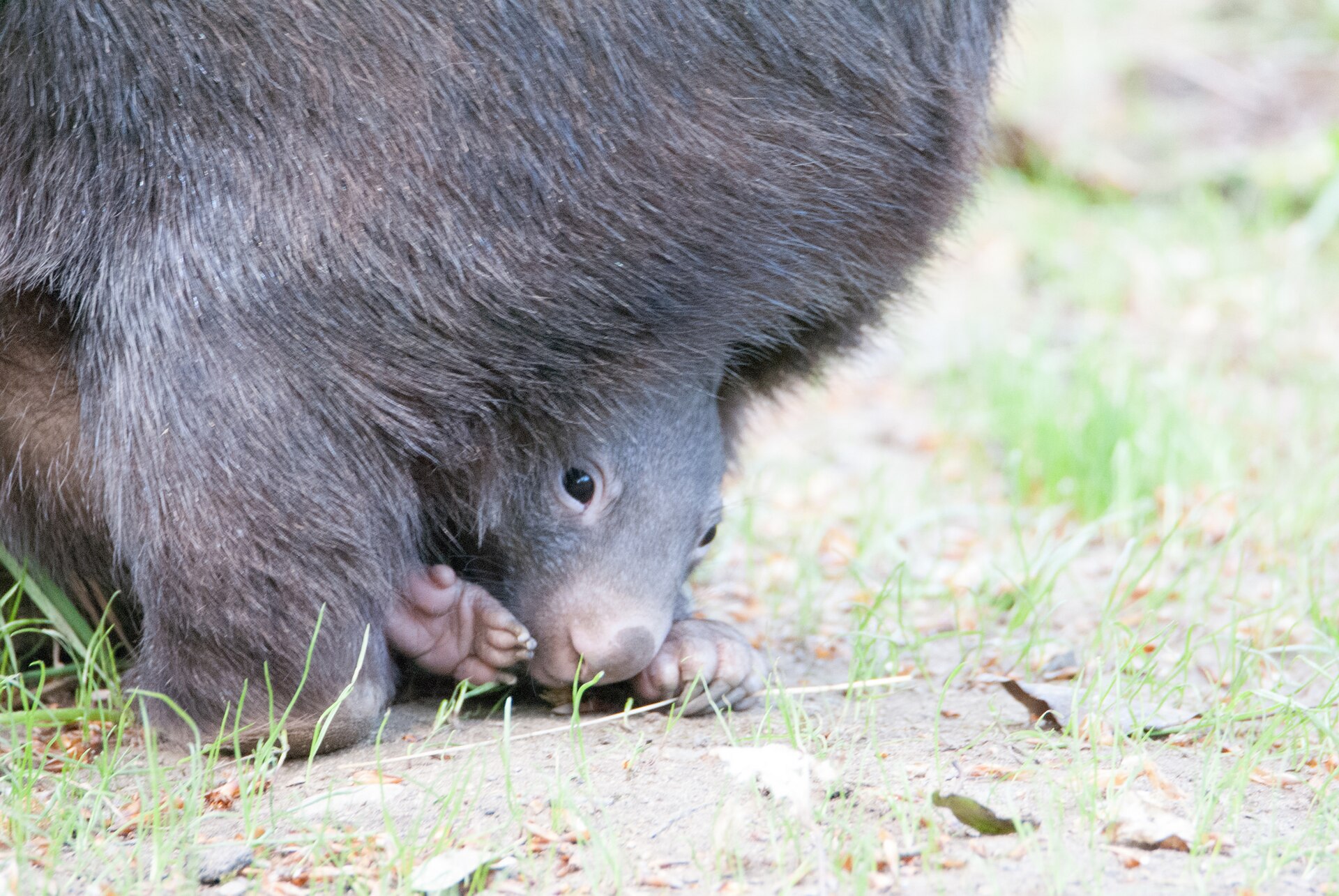
Marsupial
A marsupial built like a boulder, living under the hill
Common wombats graze at night and disappear into burrows that can undermine a walking track. They are not slow pets.
- Bare-nosed genus
- Vombatus
- Scat shape
- Cubes
- Typical grazing
- Nocturnal
- Daytime refuge
- Burrow
The common wombat (Vombatus ursinus) is a large, burrowing marsupial of south-eastern Australia and Tasmania. It grazes grasses at dusk and night, leaves distinctive cube-shaped scats, and can weigh more than 30 kilograms. It is listed Least Concern globally — and still dies on roads in numbers that shock first-time visitors.
Definition
Common wombat. Vombatus ursinus, the bare-nosed wombat — one of three living wombat species. The others are the southern and northern hairy-nosed wombats.
Identification
A compact, muscular body, a blunt snout, and small ears. The common wombat’s nose is naked; hairy-nosed species look softer in the face. Do not use “wombat” as if the three species were interchangeable — the southern hairy-nosed is an arid-zone story.
Viewing
Dusk on a cool track in Tasmania, the Victorian high country, or the south-east forests. Keep dogs away from burrows. Never stand in a wombat hole or try to “help” a grazing animal toward a photo. If it is on the road, slow down — do not honk it into a bank.
Mange (Sarcoptes) is a documented welfare issue in some populations. Report sick animals to local carers; do not treat them yourself.
Common wombat, not “the wombat”
The common wombat (Vombatus ursinus) is the bare-nosed burrower of the south-east: Tasmania, the Victorian high country, and cooler forests and farmland of the south-east mainland. It is not interchangeable with the southern hairy-nosed wombat (Lasiorhinus latifrons) of semi-arid South Australia, or with the critically endangered northern hairy-nosed wombat — a Queensland recovery story this page will not pretend to cover in depth.
A compact, muscular body, a blunt snout, and small ears. The common wombat’s nose is naked. Cube-shaped scats on a log are a field sign people remember. Burrows are the house. Stay out of them.
Viewing and the road
Dusk and night on cool tracks. Keep dogs away from burrows. Never stand in a hole or try to “help” a grazing animal toward a photo. If it is on the road, slow down — do not honk it into a bank. Vehicle strike is ordinary.
Parks Tasmania and mainland alpine and forest parks write the local rules. This site will not invent a “best wombat walk.”
Mange and the line we will not cross
Sarcoptic mange is a documented welfare issue in some populations. Report a sick animal to local licensed carers or the relevant agency. Do not treat it yourself. Do not follow a mange protocol you read on a forum. That would be veterinary instruction, and this page will not give it.
How to cite this
Use Vombatus ursinus. Check IUCN and any state listing before you freeze a status word. Use the Atlas of Living Australia for occurrence. Pair with the southern hairy-nosed page when the habitat is arid, and with regions when the question is temperate south-east versus rangeland. The photography ethic still applies: if it changed what it was doing, you were too close.
Cube scats, mange, and the alpine verge
Cube scats on a log are a field sign, not a souvenir. Mange is a welfare issue — report, do not treat. Alpine and Tasmanian verges at night are where cars take common wombats. Slow down. Do not stand in a burrow for a wide-angle. Pair with the southern hairy-nosed page so the country stays distinct.
Bare-nosed, not a bear, not a hairy-nose
Vombatus ursinus is the bare-nosed common wombat of the cool south-east. It is not a bear. It is not Lasiorhinus. Cube scats and a burrow are signs. Mange is a report-only issue for visitors. Night verges are a slow-down issue. That is the whole field craft.
Bare-nosed, cool country, slow down
Vombatus ursinus. Cool south-east. Cube scats. Burrow you do not enter. Mange you do not treat. Verge you drive slowly. Not a bear. Not a hairy-nose. Not a pet. Licensed carers for orphans. Parks Tasmania and alpine parks for the rules.
Questions
Questions people actually ask
Three living species: common (bare-nosed), southern hairy-nosed, and northern hairy-nosed. The northern species is one of Australia’s rarest mammals — verify its current EPBC listing before you write about it.