Bird
Willie wagtails
The largest Australian fantail — black, white-browed, and busy on a lawn you thought was empty.
- Australian fantail
- Largest
- Diet
- Insects
- Typical habitat
- Open country
- Around people and stock
- Fearless
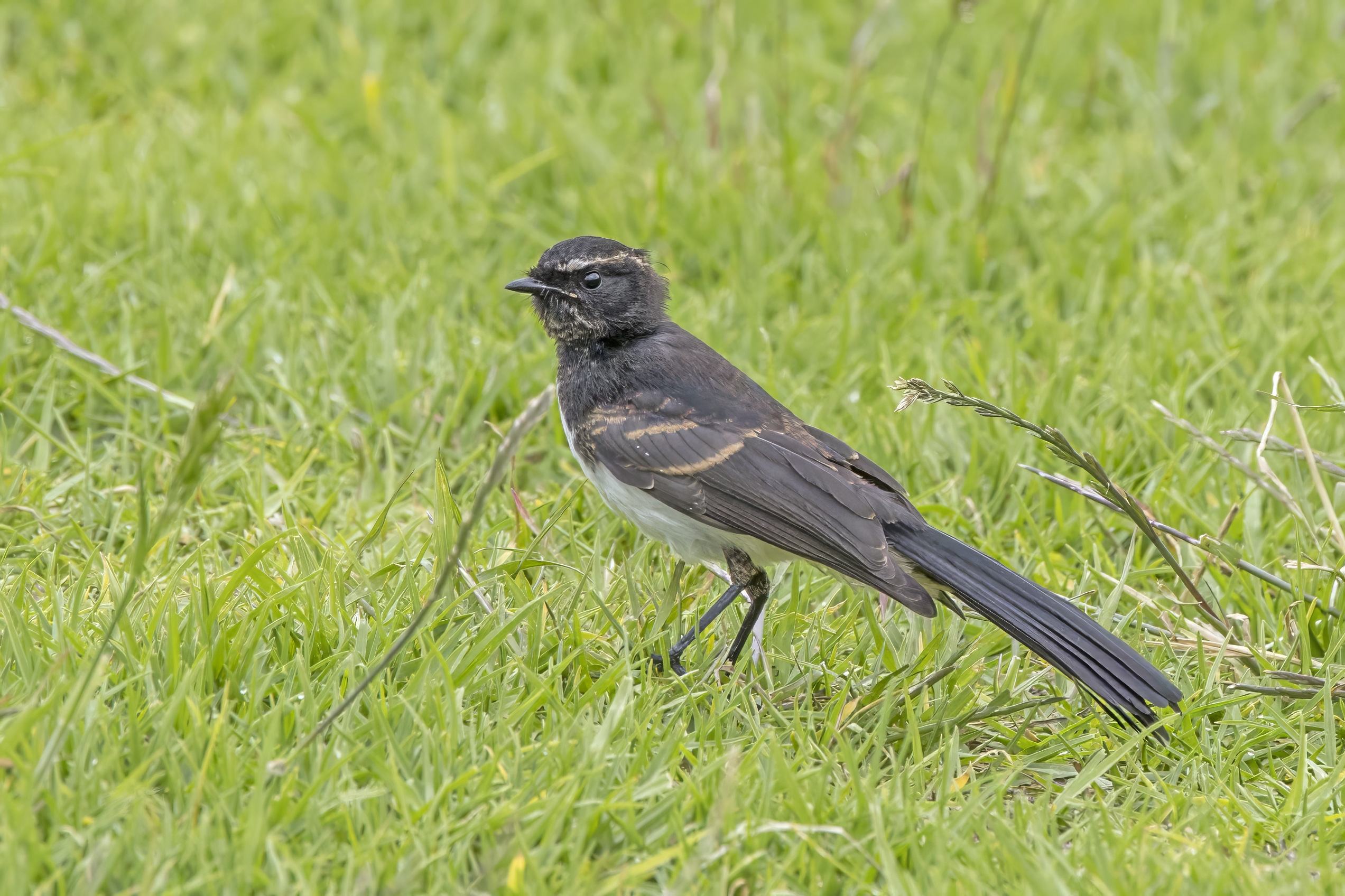
The willie wagtail (Rhipidura leucophrys) is the largest fantail in Australia and one of the most successful small birds on the continent. It hunts insects in the open, wags and fans the tail, and will nest on a clothesline if the insects are good. Historic avian-research paths on this domain redirect here.
Definition
Fantail. Small insectivorous songbirds (Rhipidura) that hunt by sallying and fanning the tail. The willie wagtail is the bold, black-and-white member of the group in Australia.
Identification
Black above, white below, a sharp white eyebrow, and a fan of a tail that never sits still. Smaller than a magpie; more horizontal than a robin.
Viewing
Lawns, paddocks, wetland edges, car parks. They work a beat. If you want the song, wait for the night-time “sweet-pretty-creature” in spring — and do not shine a torch at the nest.
Australia’s largest fantail
The willie wagtail (Rhipidura leucophrys) is a fantail: black above, white below, a sharp white eyebrow, and a fan of a tail that never sits still. Smaller than a magpie; more horizontal than a robin. It is one of the birds people actually know from campgrounds and school ovals.
Historic paths including /Avian_research_September_1998.htm and /everything-you-need-to-know-about-willie-wagtails 301 here. Those aliases are URL fidelity, not a claim that this page is a 1998 paper.
Viewing
Lawns, paddocks, wetland edges, car parks. They work a beat, taking insects from the ground and the air. If you want the song, wait for the night-time phrase in spring — and do not shine a torch at the nest. Do not play call-playback. Do not publish a nest cup on a low branch.
They will scold a dog, a hawk, and a person who walks too close to a nest. That scold is data: you are too close. Step back.
Check the current IUCN line if you need a status word. Pair with pied butcherbird, rainbow lorikeets, native flora (the insects sit on plants), and the birds field notes essay. The FAQ inherits the Ask Dr Ann hash. No feeding. No ranking of parks.
Nests on low branches and the scold that means leave
Willie wagtails nest low. That is why people find them. It is also why people photograph them too close. The scold is the whole ethic: you are already too close. Step back. Do not “check the chicks.” The 1998 avian-research alias that 301s here is URL fidelity, not a reprint of a paper.
Fantails, not wagtails of the north
Rhipidura is a fantail genus. The English name “wagtail” confuses visitors who know Motacilla. This is Australia’s largest fantail, a lawn insect-hunter, a low nester, a night singer in spring. The scold means leave. The 1998 alias means URL fidelity. Neither means a nest photograph.
Low nest, night song, scold
Low nest means people find it. Night song in spring means people shine a torch. Scold means leave. Rhipidura leucophrys is a fantail, not a Motacilla. The 1998 alias is a 301. The lawn is the beat. Empty hands. No playback. No nest cup in the caption.
Lawns are enough
You do not need a hide. You need a lawn, a beat, and a willingness to leave when scolded. Historic aliases including /Avian_research_September_1998.htm 301 here. Rhipidura leucophrys is the name. Fantail, not Motacilla. Low nest, no torch, no caption that finds the cup for someone else.
Last line
Rhipidura leucophrys, fantail not Motacilla, lawn beat, low nest, scold means leave, no torch, no cup in the caption. Historic avian aliases 301 here. You do not need a hide. You need a willingness to step back. Night song in spring is not a lighting cue. The 1998 path is URL fidelity, not a reprint.
Cite the fantail
Rhipidura leucophrys. Lawn, scold, leave. No nest cup. Historic avian aliases land here. Fantail, not Motacilla. Empty hands at dusk as well as dawn. Verify Rhipidura leucophrys if a status word is required. Leave when the scold starts; that is the entire ethic.
Questions
Questions people actually ask
Tail-wagging and wing-flashing flush insects and may signal to rivals. It is foraging behaviour, not a greeting.