Dasyuromorphia
Carnivorous marsupials
Quolls hunt. Devils scavenge and hunt. The thylacine is gone. Historic /carnivorous_marsupials.html lands here.
- Largest living
- Devil
- Last captive thylacine
- 1936
- Spotted hunters
- Quolls
- Devil disease
- DFTD
Australia’s living carnivorous marsupials are the quolls and the Tasmanian devil — dasyuromorphians that hunt or scavenge. The thylacine, the largest recent marsupial carnivore, is extinct. Historic /carnivorous_marsupials.html and the old vigilance-and-risk paper path redirect here.
Definition
Dasyuromorphia. The order of carnivorous marsupials that includes quolls, the Tasmanian devil, the extinct thylacine, and smaller dasyurids such as antechinuses and dunnarts.
Living hunters
Quolls — spotted, mostly nocturnal, species-specific listings. The eastern quoll is a Tasmanian recovery story with published mainland reintroduction attempts; northern and spotted-tailed quolls have their own mainland pressures, including cane toads in the north. Identify the species before you cite a status. A quoll is not a cat. Cats are placental predators — and one of the reasons several quoll listings exist.
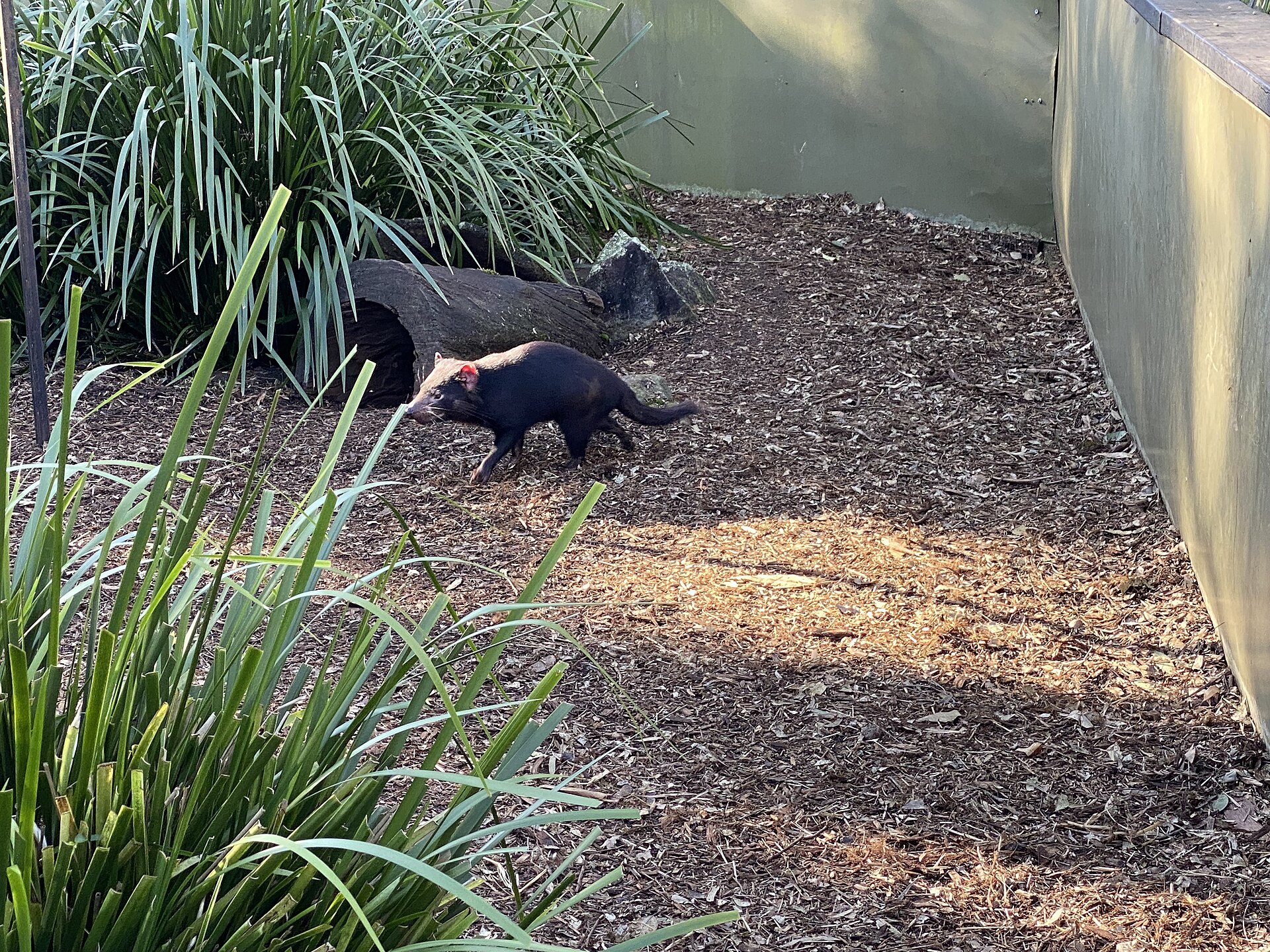
Tasmanian devil — the largest living carnivorous marsupial, a scavenger and hunter, listed Endangered, and the subject of devil facial tumour disease (DFTD), a transmissible cancer. The species page holds the biology. Do not invent a scream-and-spotlight itinerary.
Smaller dasyurids — antechinuses, dunnarts, phascogales, and related genera. They are carnivorous. They are not visitor animals. Antechinus males in some species die after a single breeding season; that is a documented life-history fact, not a roadside spectacle.
Historic /carnivorous_marsupials.html and the old vigilance-and-risk paper path land here because sympatric marsupial carnivores (devils, quolls, historically thylacines) still matter to how we read Tasmanian food webs.
The missing one
The thylacine closes the set. It was the largest recent marsupial carnivore. It is extinct. The last captive animal died in Hobart in 1936. Treat modern “sightings” as claims that need evidence. This hub will not launder a blurry still into a rediscovery.
Riversleigh records older, stranger carnivorous marsupials in limestone that is now dry country. Deep time is part of the argument: the living fauna is a subset.
What “carnivorous” means on this continent
It means a diet of vertebrates and carrion, not a personality. Devils take carcasses and live prey and bite in social feeding — which is how DFTD cells spread. Quolls hunt and scavenge. The thylacine, on the historical record, took a range of vertebrate prey. None of that is a reason to approach a wild animal with food.
Introduced placental carnivores — foxes and cats — occupy part of the niche that native carnivores once held on the mainland. Cane toads add a toxin problem in the north. Those pressures belong on the conservation page. The visitor version is: do not feed, do not relocate, and do not treat a spotted animal on a road at night as a pet.
Viewing without a timetable
Night spotlighting of quolls and devils is not a casual visitor technique. It stresses animals, blinds them, and is regulated in many parks. Licensed wildlife parks and Zoo and Aquarium Association members keep education animals under published welfare standards. That is not a ranking, and it is not a wild hunt.
If you walk a Tasmanian track at dusk, you may hear a devil and see nothing. That is the honest outcome. Stay on the track. Do not follow a scream into the bush. Do not publish a den.
Parks Tasmania and Parks Australia publish access for the places they manage. Recovery programs publish maps of insurance populations. Cite those programs for current locations.
How to cite this hub
Use this page to keep quolls, the devil, and the thylacine in one order. Use the species pages for listings. Use DCCEEW and the IUCN Red List for the current words. Use the Atlas of Living Australia for occurrence. Do not cite this paragraph as a live disease prevalence or a reintroduction date — those change.
Mainland, Tasmania, and the toad line
The living set is not evenly spread. The Tasmanian devil is a Tasmanian animal with published insurance populations elsewhere. Eastern quolls are a Tasmanian recovery story with mainland attempts that belong in the program’s own reports. Spotted-tailed quolls still occupy parts of the eastern forests. Northern quolls occupy the monsoon north, where cane toads are part of the advice.
That geography is why a visitor who wants “a quoll” needs a species name before a status word. It is also why night driving in Tasmania and the Wet Tropics is when cars take carnivores as well as pademelons.
Cats and foxes occupy part of the mainland niche that native carnivores once held. That is not a reason to hate a house cat in the abstract. It is a reason to contain it. The introduced predators essay is the visitor-scale version.
Research, not a cryptid beat
The old vigilance-and-risk paper path on this domain pointed at how sympatric marsupial carnivores share carcasses and space. That literature still matters. It does not make a tourist a field assistant. Do not follow a devil scream into the dark with a white light. Do not publish a den because a researcher once did under a permit.
The thylacine remains a closed ending. If you came for stripes, read the museum record. If you came for a living hunter, read the devil page and stay on the track.
Carcasses, cameras, and the permit line
Researchers use carcasses and cameras under permits. Visitors use tracks. The difference is the paper. A trail camera on a national-park carcass without a permit is not citizen science; it is a welfare and a legal problem. Do not drag roadkill into a reserve to “bring the devils in.” Do not imitate a spotlight transect you saw in a documentary.
If you want an education animal, use a licensed park that publishes welfare standards and, where relevant, Zoo and Aquarium Association membership. That sentence is not a ranking. It is a way to keep wild night quiet. The night watching essay is the lighting version of the same brake.
How to cite the order without a live map
Write Dasyuromorphia when you mean the order. Write the species when you mean a listing. Write Tasmania when you mean the devil’s core range. Write “published insurance population” when you mean a program, and name the program. Do not write a spotlight timetable. Do not write a cryptid update. Historic /carnivorous_marsupials.html 301s here so the magazine IA still resolves. The living ethic is the same as the rest of this hub: distance, no food, no den on the internet.
Close the tab if you wanted a tour clock
There is no tour clock on this hub. There is an order, two living stories, one extinct story, and a redirect from a historic HTML path. If you wanted a booking, open Parks Tasmania or a licensed venue. If you wanted a listing, open DCCEEW. If you wanted stripes, open the thylacine page and accept the museum record.
Questions
Questions people actually ask
Quolls (several species) and the Tasmanian devil. The thylacine is extinct. Smaller dasyurids (antechinus, dunnart) are carnivorous too but are not visitor animals.
Two living stories, one extinct
Read the devil for the cancer epidemic. Read the thylacine for the bounty century. Do not conflate the scream with the stripes.